
“When selecting a school for your children, you are kind of doubtful that you’ve made the right choice, until you get to Heritage: truly built for pupils; small classes; warming family environment; safe and respectful; solid education based on knowledge as a relation and not information. Children flourish.”
— Junior School Parent
Days in the Junior School are full of variety. Short, focused lessons provide learning refreshment and hold attention. This practice is extended for our very youngest learners with Reception class having three short days per week, finishing at 1pm on Mondays, Wednesdays and Fridays, moving to one short day on Wednesdays when they go to Year 1. Pupils are absorbed in their learning with excellent attention and retention. Learning is effective and no time is wasted.
Pupils study separate subjects from the start, for example History lessons start in Reception with separate Biology, Chemistry and Physics from Year 2 and Classics from Year 5.
“When selecting a school for your children, you are kind of doubtful that you’ve made the right choice, until you get to Heritage: truly built for pupils; small classes; warming family environment; safe and respectful; solid education based on knowledge as a relation and not information. Children flourish.”
— Junior School Parent
Days in the Junior School are full of variety. Short, focused lessons provide learning refreshment and hold attention. This practice is extended for our very youngest learners with Reception class having three short days per week, finishing at 1pm on Mondays, Wednesdays and Fridays, moving to one short day on Wednesdays when they go to Year 1. Pupils are absorbed in their learning with excellent attention and retention. Learning is effective and no time is wasted.
Pupils study separate subjects from the start, for example History lessons start in Reception with separate Biology, Chemistry and Physics from Year 2 and Classics from Year 5.
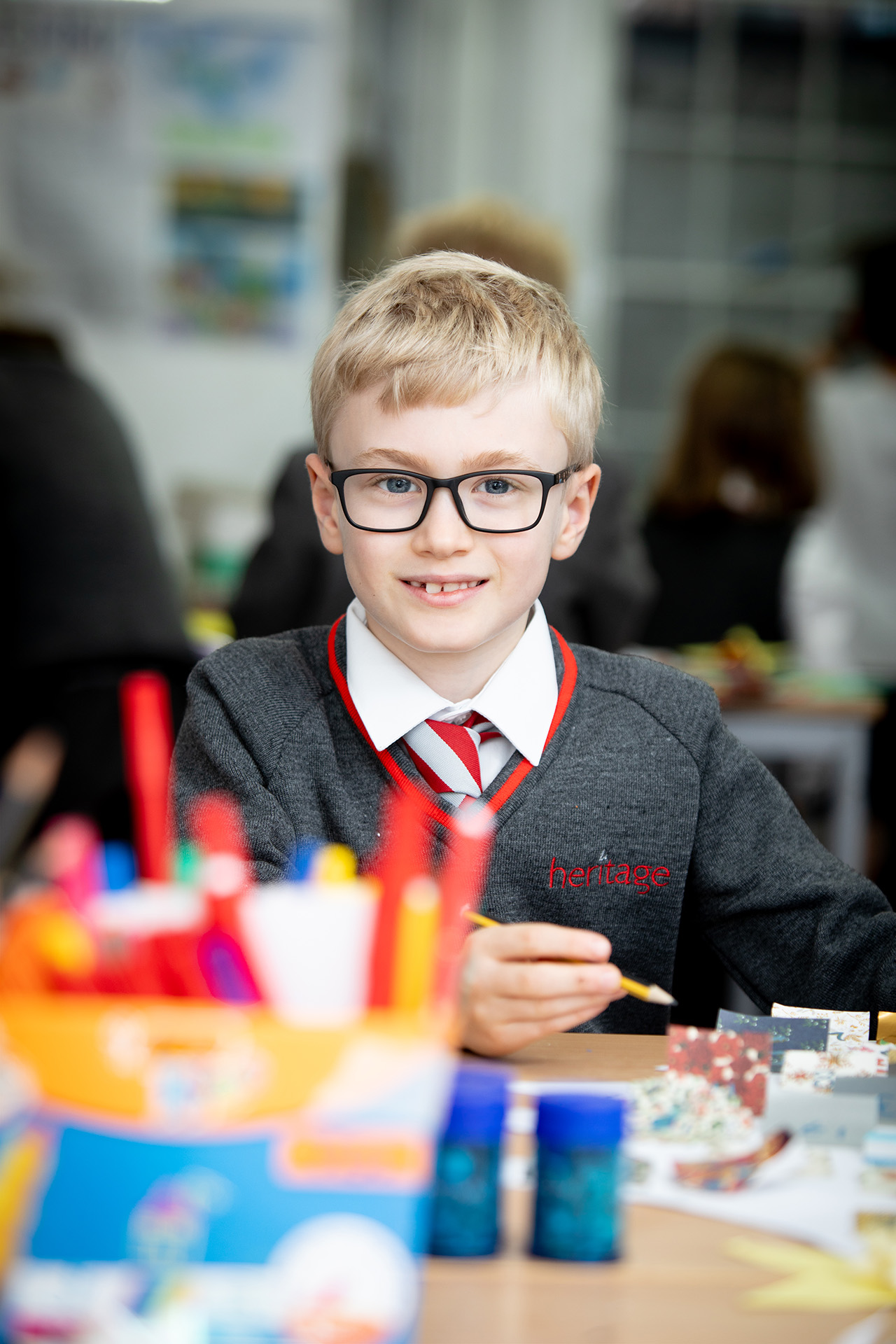
Narration is a strong strand of learning from Years 2 – 6. It involves reading to pupils from a well-chosen book of history or literature, for example, and then pupils are expected to re-tell what they heard point for point, having heard it only once.
Our goal is to enable pupils to put their learning together, to see connections and the bigger picture. This includes the ‘Book of Centuries’, which pupils develop throughout their time at school. Classrooms act as a narrative learning resource with history timelines coming to life around the walls as a new figure in history is studied. As pupils learn about artists, scientists, composers, authors, poets and other notable figures they too find their place on the timeline. These timelines, together with each classroom’s map of the world, nature table, pictures of their composer and artist of the term together with the artist’s paintings, give pupils a constant touchstone for for their learning and how it all fits together.
Our curriculum in our Infant and Junior School is strongly shaped by Charlotte Mason’s educational philosophy.
Narration is a strong strand of learning from Years 2 – 6. It involves reading to pupils from a well-chosen book of history or literature, for example, and then pupils are expected to re-tell what they heard point for point, having heard it only once.
Our goal is to enable pupils to put their learning together, to see connections and the bigger picture. This includes the ‘Book of Centuries’, which pupils develop throughout their time at school. Classrooms act as a narrative learning resource with history timelines coming to life around the walls as a new figure in history is studied. As pupils learn about artists, scientists, composers, authors, poets and other notable figures they too find their place on the timeline. These timelines, together with each classroom’s map of the world, nature table, pictures of their composer and artist of the term together with the artist’s paintings, give pupils a constant touchstone for for their learning and how it all fits together.
Our curriculum in our Infant and Junior School is strongly shaped by Charlotte Mason’s educational philosophy.
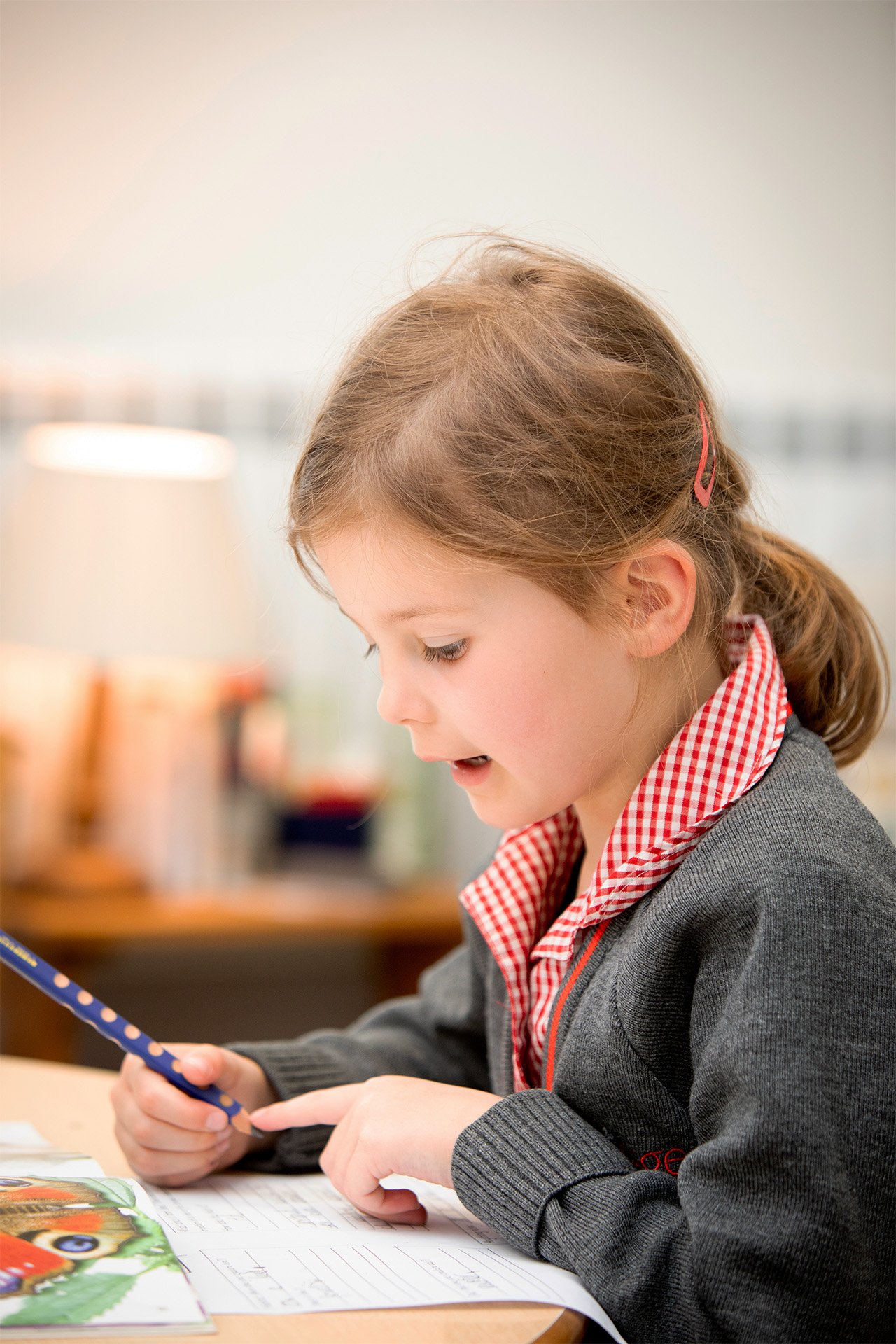
Infant and Junior School Curriculum
Art, Culture and Handicraft
Alongside their academic studies Junior School pupils enjoy dedicated Art lessons.
There are separate Art and Handicraft lessons each week from Reception onwards, taught by specialists from Year 1. From Year 2 pupils have lessons in our Art Room learning how to do many things from weaving on individual looms, sewing, clay work, and knitting to painting, sketching, observational work, pastiche and more. For our youngest pupils, art activities often allow them to creatively respond to what they have been learning about, through painting, collage, drawing and model making; sometimes independently and sometimes collaboratively. At other times they might be encouraged to look carefully at a daffodil or holly leaf, for example, and try to copy the shape and colour of it. An after-school Art Club for Juniors normally runs throughout the year.
We focus throughout the school upon art appreciation. In particular, from Year 2 to Year 6, pupils participate in a Picture Study lesson each week. Following a brief introduction by the class teacher, pupils look in silence with concentrated attention at a reproduction of a painting by a famous artist. The painting is then turned over and its details are described from memory. In this way pupils study numerous works by that artist each term. Over the years they become familiar with a large number of great works by artists such as: Giotto, Leonardo Da Vinci, Vermeer, De Hooch, Holbein, Rembrandt, Titian, Constable, Monet, Manet, Turner, Cezanne, Cassatt, Van Gogh, Degas, and Picasso. After studying so much art in this way, pupils take real pleasure when they are able to see the original in a London museum, or even a 10 minute walk away at the Fitzwilliam Museum.
Classics
Classics lessons are introduced from Year 5 with pupils taking their first steps in learning Latin and engaging with the stories and history of the Classical World as far as possible as told by the Classical authors themselves (Homer, Herodotus, Arrian, Virgil etc.). Studying Classics from age 9 was something which Charlotte Mason championed in her schools believing that, “culture begins with the knowledge that everything has been known and everything has been perfectly said these two thousand years ago and more…” we follow the same at Heritage. There is the rigour of the Latin language, the grammar, the foundation for understanding so many roots of words, the inspiration of the stories and great heroes.
Computer Science
Computer Science lessons are where screens can be found at Heritage. Computers are remarkable tools of unparalleled efficiency, and we want our pupils to understand how they work in addition to learning how to use them.
From Year 6 pupils begin a three-year computing course that progressively develops their understanding of coding. Using Raspberry Pi computers, Chromebooks and Microbits, pupils learn how to create new environments such as animations and games. Pupils study the different components and structures of code, ultimately translating them into Python coding language.
The development of typing proficiency is also developed at this stage.
Drama
Drama gives pupils an opportunity to grow in many important ways. Pupils develop unique empathy with their characters, an ability to confidently express themselves publicly, and a capacity to work effectively with others as part of a team. They experience the excitement and sense of achievement that comes from seeing a production through from beginning to end, including all of the practical elements such as staging and costuming. While there are occasional opportunities to enjoy Drama lower down the school, such as during class assemblies and as part of our Enrichment Programme, Drama commences in earnest in Year 5. In that year, and again in Year 6, pupils perform a class play each year.
English
Reading is the access point for so much learning. Infants and Juniors spend 20 – 25 minutes every day reading aloud. Charlotte Mason believed stories to be a powerful tool able to convey ‘living ideas’ to nourish the mind, firing the imagination, emotions and helping children develop their own moral judgement. Heritage fosters a love of reading stories with a firm focus on enjoyment over analysis. Pupils have two books which they read together each term, a classic for Literature and a more contemporary choice for ‘Read Aloud’, a lesson which rounds off every school day. Learning poetry by heart is beneficial for oracy, developing memory and cognitive skills, gaining deeper emotional insights and building strong emotional connections to words. Heritage pupils learn to recite poetry in Reception, learning six poems each year and by the end of Juniors will also have performed one of Shakespeare’s plays. These are two practices which pupils continue right through to Year 11.
Alongside reading pupils have dedicated handwriting lessons and work towards using a fountain pen.
By the time they leave Heritage in Year 11 every pupil will have learned 72 poems and read 72 novels with their classmates, including a notable number of classics.
Geography
Our youngest pupils learn about different countries around the world through hands on experiences, such as trying on saris and silks from India, grinding up aromatic spices, or dancing to the rhythm of African drums. Parents who have lived in other countries often contribute to such sessions. Map skills are developed, for example, by looking at journeys fictional characters have taken, marking a route on a map of the Botanical Gardens and writing directions to get around the school. Reading stories from the four countries making up Great Britain and identifying key landmarks within Cambridge helps familiarise pupils with their own country. The names of continents and seas are learned through song. Physical land forms, such as the highest mountain and or the longest mountain range, are identified and explored as are, for example, the differences between a pond, a lake and a river.
In our Junior School, we focus in greater depth upon knowledge of capitals, countries, water forms and land forms. We expect pupils to memorise these geography facts, with help from songs where possible. In Year 6, for instance, all the countries of Asia, North America and South America are learned over the course of the three terms. In addition, pupils look at what life is like in the countries and continents they are studying. Travel writing, letters, leaflets, and journal entries all give them an opportunity to engage with different cultures in a personal way.
History
Charlotte Mason saw History as a foundational backbone which when studied chronologically through engaging ‘living books’ fosters a deep understanding of the past needed to comprehend the present. We have witnessed this theory in action. Starting in Junior School pupils build their own ‘Book of Centuries’, a folder of History which tells a chronological history as they learn. Pupils in Reception to Year 2 cover a broad sweep of British History and Years 3 – 6 a sweep of world history.
Mathematics
Through song, games and a hands-on practical approach using abacus our youngest pupils begin to see how numbers are put together and broken down. We predominantly use a programme called Right Start Maths that places a strong emphasis on non-counting strategies and enables young children to understand different mathematical processes on a visual and kinaesthetic way. New concepts are taught without a number ceiling so that once understood, a child can apply their understanding to any number. It is exciting for young children to work with big numbers and Right Start introduces hundreds and thousands early on. Being able to manipulate numbers and visualise patterns enhances understanding and confidence as well as aiding mental arithmetic.
In Years 4,5 and 6 we use the Galore Park Maths Scheme who provide rigorous, challenging and engaging resources.
White Rose Maths resources support maths learning from Reception to Year 6, these materials are built around small-step, mastery-based schemes of learning, designed to support children as they have fun with maths, exploring everything from times tables and number bonds to money and multiplication.
Modern Languages
Learning languages helps expand pupils’ understanding of the world around them, fostering an appreciation of different cultures and traditions. At Heritage our aim is make learning languages fun and accessible and to encourage a love of languages that stays with pupils throughout life. Language teaching begins as soon as pupils join in Reception. From Reception to Year 2 French is taught through stories, songs, poems and games. This continues into Years 3 and 4 when an introduction to written French and basic grammar is added. The focus remains on listening and speaking in Years 5 and 6 with more opportunities for reading and writing in French. As they progress into the Senior School all pupils continue to study French and also begin learning Spanish.
Music
Our Music programme at Heritage aims to inspire all pupils to develop a love of music, at whatever stage of their musical journey they are on.
From Reception through to Year 6 all pupils have regular whole-class music lessons with a specialist teacher. Infants have one thirty-minute lesson each week, focusing on pitch matching, steady beat and composing, learned through games, movement and song.
In the Junior school, students develop their vocal skills and general musicianship through whole-class singing. In addition, year 3 learn about notation and they develop basic composition skills using glockenspiels. Year 4 learn to play the recorder, year 5 learn to play the ocarina, and year 6 learn to play the ukulele. Each class works towards a whole-class performance for the Spring concert, where each child sings in various choirs and plays their classroom instrument.
In addition to whole-class music lessons, Infants and Juniors have dedicated curriculum time for music appreciation. Reception and Year 1 learn about and listen to works by Vivaldi, Saint-Saens, Grieg, Tchaikovsky and Prokofiev. Pupils from Year 2 have regular Composer Study lessons in addition to Music lessons, during which they read a biography of great composers – one each term – and listen to works by that composer. In this way, over five years, they learn about Medelssohn, Verdi, Williams, Chopin, Mozart, Beethoven, Haydn, Brahms, Schubert, Bach, Handel, Grieg, Schumann, and Paganini.
Religious Studies
Religious Studies supports the Christian ethos of Heritage School without excluding other philosophies and faiths. The key objective of our Religious Studies curriculum is to encourage our students to think for themselves about life’s biggest questions.
One way this is facilitated is through Bible readings. We think all pupils should be familiar with its main stories and themes, given its historical and cultural significance. Readings of Old and New Testament stories take place most days throughout the school, after which Infant and Junior pupils narrate (tell back) what they have just heard. Christian beliefs, values and history are explored by our Juniors through the reading of a biography of an inspiring Christian each year.
Respecting other beliefs, traditions and ways of life is vital in our multicultural society. In Year 4 pupils begin learning about other monotheistic faiths, first Judaism in Year 4 and then Islam in Year 5. Year 6 pupils learn about the beliefs and practices of Buddhists and Hindus, with an emphasis upon key stories.
Science and Natural History
Studying Science as three subjects, Biology, Chemistry and Physics starts in Junior School. From Year 1 to 6 lessons and experiments are accompanied by Science Biography with pupils learning about the key figures in the break throughs of Science for example, Archimedes, Galileo, Newton, Marie Curie and the Wright Brothers.
Learning in nature is a central part of Charlotte Mason’s philosophy and nature walks play a big part in pupils’ learning. Reception and Year 1 enjoy weekly nature walks, whilst Years 2 – 6 are out and about on alternate weeks. Nature walks place emphasis on observation and children becoming familiar with flora and fauna. Pupils learn about a minimum of two new species each term and find things to identify, paint in their Nature Notebooks and to display on their classroom nature tables.
Enrichment
From Junior School through to Year 8 in Seniors the weekly timetable includes a scheduled Enrichment afternoon.
Infant and Junior School Curriculum
Art, Culture and Handicraft
Alongside their academic studies Junior School pupils enjoy dedicated Art lessons.
There are separate Art and Handicraft lessons each week from Reception onwards, taught by specialists from Year 1. From Year 2 pupils have lessons in our Art Room learning how to do many things from weaving on individual looms, sewing, clay work, and knitting to painting, sketching, observational work, pastiche and more. For our youngest pupils, art activities often allow them to creatively respond to what they have been learning about, through painting, collage, drawing and model making; sometimes independently and sometimes collaboratively. At other times they might be encouraged to look carefully at a daffodil or holly leaf, for example, and try to copy the shape and colour of it. An after-school Art Club for Juniors normally runs throughout the year.
We focus throughout the school upon art appreciation. In particular, from Year 2 to Year 6, pupils participate in a Picture Study lesson each week. Following a brief introduction by the class teacher, pupils look in silence with concentrated attention at a reproduction of a painting by a famous artist. The painting is then turned over and its details are described from memory. In this way pupils study numerous works by that artist each term. Over the years they become familiar with a large number of great works by artists such as: Giotto, Leonardo Da Vinci, Vermeer, De Hooch, Holbein, Rembrandt, Titian, Constable, Monet, Manet, Turner, Cezanne, Cassatt, Van Gogh, Degas, and Picasso. After studying so much art in this way, pupils take real pleasure when they are able to see the original in a London museum, or even a 10 minute walk away at the Fitzwilliam Museum.
Classics
Classics lessons are introduced from Year 5 with pupils taking their first steps in learning Latin and engaging with the stories and history of the Classical World as far as possible as told by the Classical authors themselves (Homer, Herodotus, Arrian, Virgil etc.). Studying Classics from age 9 was something which Charlotte Mason championed in her schools believing that, “culture begins with the knowledge that everything has been known and everything has been perfectly said these two thousand years ago and more…” we follow the same at Heritage. There is the rigour of the Latin language, the grammar, the foundation for understanding so many roots of words, the inspiration of the stories and great heroes.
Computer Science
Computer Science lessons are where screens can be found at Heritage. Computers are remarkable tools of unparalleled efficiency, and we want our pupils to understand how they work in addition to learning how to use them.
From Year 6 pupils begin a three-year computing course that progressively develops their understanding of coding. Using Raspberry Pi computers, Chromebooks and Microbits, pupils learn how to create new environments such as animations and games. Pupils study the different components and structures of code, ultimately translating them into Python coding language.
The development of typing proficiency is also developed at this stage.
Drama
Drama gives pupils an opportunity to grow in many important ways. Pupils develop unique empathy with their characters, an ability to confidently express themselves publicly, and a capacity to work effectively with others as part of a team. They experience the excitement and sense of achievement that comes from seeing a production through from beginning to end, including all of the practical elements such as staging and costuming. While there are occasional opportunities to enjoy Drama lower down the school, such as during class assemblies and as part of our Enrichment Programme, Drama commences in earnest in Year 5. In that year, and again in Year 6, pupils perform a class play each year.
English
Reading is the access point for so much learning. Infants and Juniors spend 20 – 25 minutes every day reading aloud. Charlotte Mason believed stories to be a powerful tool able to convey ‘living ideas’ to nourish the mind, firing the imagination, emotions and helping children develop their own moral judgement. Heritage fosters a love of reading stories with a firm focus on enjoyment over analysis. Pupils have two books which they read together each term, a classic for Literature and a more contemporary choice for ‘Read Aloud’, a lesson which rounds off every school day. Learning poetry by heart is beneficial for oracy, developing memory and cognitive skills, gaining deeper emotional insights and building strong emotional connections to words. Heritage pupils learn to recite poetry in Reception, learning six poems each year and by the end of Juniors will also have performed one of Shakespeare’s plays. These are two practices which pupils continue right through to Year 11.
Alongside reading pupils have dedicated handwriting lessons and work towards using a fountain pen.
By the time they leave Heritage in Year 11 every pupil will have learned 72 poems and read 72 novels with their classmates, including a notable number of classics.
Geography
Our youngest pupils learn about different countries around the world through hands on experiences, such as trying on saris and silks from India, grinding up aromatic spices, or dancing to the rhythm of African drums. Parents who have lived in other countries often contribute to such sessions. Map skills are developed, for example, by looking at journeys fictional characters have taken, marking a route on a map of the Botanical Gardens and writing directions to get around the school. Reading stories from the four countries making up Great Britain and identifying key landmarks within Cambridge helps familiarise pupils with their own country. The names of continents and seas are learned through song. Physical land forms, such as the highest mountain and or the longest mountain range, are identified and explored as are, for example, the differences between a pond, a lake and a river.
In our Junior School, we focus in greater depth upon knowledge of capitals, countries, water forms and land forms. We expect pupils to memorise these geography facts, with help from songs where possible. In Year 6, for instance, all the countries of Asia, North America and South America are learned over the course of the three terms. In addition, pupils look at what life is like in the countries and continents they are studying. Travel writing, letters, leaflets, and journal entries all give them an opportunity to engage with different cultures in a personal way.
History
Charlotte Mason saw History as a foundational backbone which when studied chronologically through engaging ‘living books’ fosters a deep understanding of the past needed to comprehend the present. We have witnessed this theory in action. Starting in Junior School pupils build their own ‘Book of Centuries’, a folder of History which tells a chronological history as they learn. Pupils in Reception to Year 2 cover a broad sweep of British History and Years 3 – 6 a sweep of world history.
Mathematics
Through song, games and a hands-on practical approach using abacus our youngest pupils begin to see how numbers are put together and broken down. We predominantly use a programme called Right Start Maths that places a strong emphasis on non-counting strategies and enables young children to understand different mathematical processes on a visual and kinaesthetic way. New concepts are taught without a number ceiling so that once understood, a child can apply their understanding to any number. It is exciting for young children to work with big numbers and Right Start introduces hundreds and thousands early on. Being able to manipulate numbers and visualise patterns enhances understanding and confidence as well as aiding mental arithmetic.
In Years 4,5 and 6 we use the Galore Park Maths Scheme who provide rigorous, challenging and engaging resources.
White Rose Maths resources support maths learning from Reception to Year 6, these materials are built around small-step, mastery-based schemes of learning, designed to support children as they have fun with maths, exploring everything from times tables and number bonds to money and multiplication.
Modern Languages
Learning languages helps expand pupils’ understanding of the world around them, fostering an appreciation of different cultures and traditions. At Heritage our aim is make learning languages fun and accessible and to encourage a love of languages that stays with pupils throughout life. Language teaching begins as soon as pupils join in Reception. From Reception to Year 2 French is taught through stories, songs, poems and games. This continues into Years 3 and 4 when an introduction to written French and basic grammar is added. The focus remains on listening and speaking in Years 5 and 6 with more opportunities for reading and writing in French. As they progress into the Senior School all pupils continue to study French and also begin learning Spanish.
Music
Our Music programme at Heritage aims to inspire all pupils to develop a love of music, at whatever stage of their musical journey they are on.
From Reception through to Year 6 all pupils have regular whole-class music lessons with a specialist teacher. Infants have one thirty-minute lesson each week, focusing on pitch matching, steady beat and composing, learned through games, movement and song.
In the Junior school, students develop their vocal skills and general musicianship through whole-class singing. In addition, year 3 learn about notation and they develop basic composition skills using glockenspiels. Year 4 learn to play the recorder, year 5 learn to play the ocarina, and year 6 learn to play the ukulele. Each class works towards a whole-class performance for the Spring concert, where each child sings in various choirs and plays their classroom instrument.
In addition to whole-class music lessons, Infants and Juniors have dedicated curriculum time for music appreciation. Reception and Year 1 learn about and listen to works by Vivaldi, Saint-Saens, Grieg, Tchaikovsky and Prokofiev. Pupils from Year 2 have regular Composer Study lessons in addition to Music lessons, during which they read a biography of great composers – one each term – and listen to works by that composer. In this way, over five years, they learn about Medelssohn, Verdi, Williams, Chopin, Mozart, Beethoven, Haydn, Brahms, Schubert, Bach, Handel, Grieg, Schumann, and Paganini.
Religious Studies
Religious Studies supports the Christian ethos of Heritage School without excluding other philosophies and faiths. The key objective of our Religious Studies curriculum is to encourage our students to think for themselves about life’s biggest questions.
One way this is facilitated is through Bible readings. We think all pupils should be familiar with its main stories and themes, given its historical and cultural significance. Readings of Old and New Testament stories take place most days throughout the school, after which Infant and Junior pupils narrate (tell back) what they have just heard. Christian beliefs, values and history are explored by our Juniors through the reading of a biography of an inspiring Christian each year.
Respecting other beliefs, traditions and ways of life is vital in our multicultural society. In Year 4 pupils begin learning about other monotheistic faiths, first Judaism in Year 4 and then Islam in Year 5. Year 6 pupils learn about the beliefs and practices of Buddhists and Hindus, with an emphasis upon key stories.
Science and Natural History
Studying Science as three subjects, Biology, Chemistry and Physics starts in Junior School. From Year 1 to 6 lessons and experiments are accompanied by Science Biography with pupils learning about the key figures in the break throughs of Science for example, Archimedes, Galileo, Newton, Marie Curie and the Wright Brothers.
Learning in nature is a central part of Charlotte Mason’s philosophy and nature walks play a big part in pupils’ learning. Reception and Year 1 enjoy weekly nature walks, whilst Years 2 – 6 are out and about on alternate weeks. Nature walks place emphasis on observation and children becoming familiar with flora and fauna. Pupils learn about a minimum of two new species each term and find things to identify, paint in their Nature Notebooks and to display on their classroom nature tables.
Enrichment
From Junior School through to Year 8 in Seniors the weekly timetable includes a scheduled Enrichment afternoon.