
“Children write lots in their exercise books and get their work marked. This is not how the majority of schools operate anymore. Work and teacher accountability is not lost in the digital ether.”
— Heritage Senior School Parent
Learning in the Senior School balances Heritage’s approach with the requirements of preparing for GCSEs.
Whilst Senior lesson times are a more conventional 45 minutes, the timetable still includes lessons and teaching unique to Heritage’s approach with many of the strands established in Junior School evolving as pupils move into their Senior School years.
Books remain at the heart of the school, with regular visits to the library, and with whole books featuring in subjects like History and Geography as well as English Literature. We have found the theory of cognitive scientist Daniel Willingham that story is ‘psychologically privileged’ in the brain to be true. We all respond to stories, have better recall with stories and enjoy stories. We have found that pupils who learn in this narrative way have excellent recall and lock in learning at a deeper level. Long-form text features in all subjects, because we know reading on paper is the optimal tool for cognitive development.
“Children write lots in their exercise books and get their work marked. This is not how the majority of schools operate anymore. Work and teacher accountability is not lost in the digital ether.”
— Heritage Senior School Parent
Learning in the Senior School balances Heritage’s approach with the requirements of preparing for GCSEs.
Whilst Senior lesson times are a more conventional 45 minutes, the timetable still includes lessons and teaching unique to Heritage’s approach with many of the strands established in Junior School evolving as pupils move into their Senior School years.
Books remain at the heart of the school, with regular visits to the library, and with whole books featuring in subjects like History and Geography as well as English Literature. We have found the theory of cognitive scientist Daniel Willingham that story is ‘psychologically privileged’ in the brain to be true. We all respond to stories, have better recall with stories and enjoy stories. We have found that pupils who learn in this narrative way have excellent recall and lock in learning at a deeper level. Long-form text features in all subjects, because we know reading on paper is the optimal tool for cognitive development.
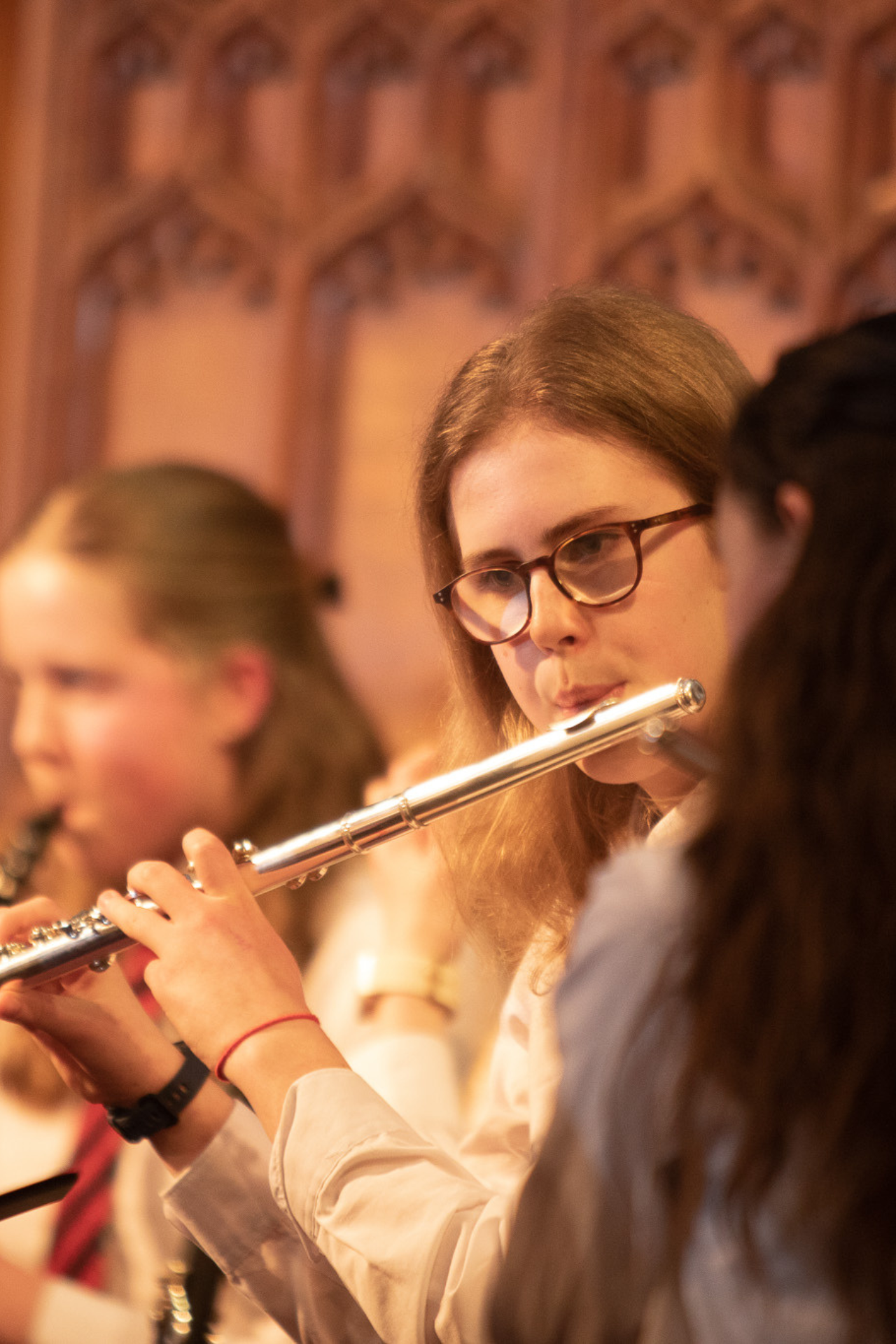
Pupils make their I/GCSE choices at the end of Year 8, rather than Year 9. This allows more teaching and learning time, enabling teachers to explore topics in greater depth, cover more topics on the syllabus, and feel less pressure to merely ‘get through the material’. Our expectation is that all pupils will take 10 I/GCSEs.
Alongside their I/GCSE studies pupils in Years 9, 10 and 11 still enjoy the hallmarks of a Heritage education – reading novels and learning poetry together as a year group, singing together in a dedicated lesson each week, enjoying timetabled enrichment lessons and thinking about life’s big questions in Heritage’s unique ‘Aspects of Wisdom’ programme.
Classrooms remain calm, purposeful and intentional places of work, free of screens. These are environments which encourage discussion, synthetic learning and deeper retention. Cambridge continues to act as an additional classroom with the city’s museums, galleries, landmarks and open spaces serving as a rich resource. For example, Year 7’s History of Architecture studies are brought to life by visiting St Benet (Saxons), the Round Church (Normans), Kings College Chapel (Tudors) and St Edward King and Martyr (the Reformation).
Pupils make their I/GCSE choices at the end of Year 8, rather than Year 9. This allows more teaching and learning time, enabling teachers to explore topics in greater depth, cover more topics on the syllabus, and feel less pressure to merely ‘get through the material’. Our expectation is that all pupils will take 10 I/GCSEs.
Alongside their I/GCSE studies pupils in Years 9, 10 and 11 still enjoy the hallmarks of a Heritage education – reading novels and learning poetry together as a year group, singing together in a dedicated lesson each week, enjoying timetabled enrichment lessons and thinking about life’s big questions in Heritage’s unique ‘Aspects of Wisdom’ programme.
Classrooms remain calm, purposeful and intentional places of work, free of screens. These are environments which encourage discussion, synthetic learning and deeper retention. Cambridge continues to act as an additional classroom with the city’s museums, galleries, landmarks and open spaces serving as a rich resource. For example, Year 7’s History of Architecture studies are brought to life by visiting St Benet (Saxons), the Round Church (Normans), Kings College Chapel (Tudors) and St Edward King and Martyr (the Reformation).
Senior School Curriculum
Art
At Heritage we seek to inspire all pupils to develop a love of art and the world around them. We want to enable them to explore and develop skills for working in various media and techniques. The skills of art appreciation initiated in the Junior School are developed as we encourage pupils to develop an understanding of artwork from different artists from different times and cultures teaching them how to analyse artworks and engage with the creative process to develop their own pieces.
In Years 7 and 8 students explore a variety of themes and art genres, including still-life, landscape and portraiture. They look at different subject matter and artwork from different artists. Each term has a different practical focus for example print, 3D and paint.
GCSE studies start in Year 9 where we aim for pupils to set their own agenda from within, making independent decisions, being self-critical and learning to accept criticism to enhance their creativity. At this stage we want pupils to engage with the artwork they produce to enhance their development as young people. GCSE studies start with a focus on further developing skills before pupils develop their individual portfolios.
Aspects of Wisdom
‘What do you think’ is a question all Senior pupils are asked within courses especially developed by Headmaster Jason Fletcher. Philosophy and Ethics lessons are part of the Year 7 and 8 curriculum and ‘Aspects of Wisdom and Religion’ are fortnightly lessons for pupils in Years 9, 10 and 11. Designed to develop critical thinking and respectful debate these courses examine life’s big questions with content covering politics, PSHE and RSE.
We see ‘wisdom’ combining ethically and philosophically astute living with practically skilful living and these courses cover a broad scope of content in these areas. Recent topics have included the characteristics of healthy relationships, substance abuse, money management, law-making, electoral systems, threats to liberal democratic values. In Year 11 the course includes an introduction to world views and how they manifest in culture recent topics have included Nihilism and Existentialism.
Biology
Senior pupils study Science as three separate strands, Biology, Chemistry and Physics.
In Biology our aim is to develop scientific skills including practical skills to produce well rounded biologists. We strive. To develop an inquiring mindset that pushes pupils to keep asking questions.
In Years 7 and 8 pupils cover a broad range of topics and lessons incorporate a range of activities including demonstrations, group work, practical work and opportunities for Harkness lessons. Topics including cells, human nutrition, reproduction, respiration, gas exchange, photosynthesis and ecosystems provide a solid foundation for the IGCSE course which pupils begin in Year 9.
Practical work and discussion work both feature prominently in IGCSE studies. A wide vocabulary is built and there is a greater emphasis on applying knowledge as pupils cover content including life processes, biological molecules, gas exchange in plants and humans, excretion in plants and humans, ecology and the environment, and genetics, including evolution.
Science features prominently within Senior pupils’ enrichment lessons, for example, Deputy Head Mr Fox, leads a four module enrichment strand in Natural History. Mr Fox’s expertise in the field has seen him contributing to a new Natural History GCSE syllabus.
Chemistry
In Chemistry our aim is to develop the scientific skills, including practical skills, to make our pupils safe and competent chemists. We want pupils to leave Heritage able to critically analyse the chemistry they meet in everyday life and have a broad understanding to scaffold new information too. As in all sciences in Heritage we aim to develop an inquiring mindset that pushes pupils to keep ask questions.
At Heritage we believe that Chemistry is the backbone of science and so all pupils study the subject to IGCSE.
A solid foundation is established in Years 7 and 8 where the curriculum includes particle theory, elements and compounds, the periodic table, metals and non-metals, acids and alkalis, chemical reactions, chemical energy ad earth structure. Lessons incorporate a range of activities including demonstrations, group work, practical work and opportunities for Harkness lessons.
IGCSE studies begin in Year 9. At this stage more maths is required and a sound understanding of ratio is developed. Lesson activities at this stage include animations, practical work and discussion work and a greater emphasis is placed on application of knowledge.
Classics
Classics remains front and centre in our Senior School. Up to Year 8 pupils’ studies are centred around arresting characters like Odysseus, Achilles, Alexander and Dido & Aeneas and in Years 9 and 10 Hannibal, Caesar and Cicero. The English texts that are read are often unadapted translations based on the original rather than summarised versions. Pupils’ learning of Latin continues and Ancient Greek is added. We believe that the studying Latin and Greek gives pupils a clearer understanding of language, equipping them with skills to communicate more effectively in English and to learn other languages more easily. Whilst learning simplified Latin in Years 7 and 8, by Years 9 and 10 pupils are regularly reading unadapted extracts of Catullus or Cicero.
Both Latin and Greek are offered at GCSE with studies commencing in Year 9. The Latin syllabus builds up knowledge of grammar and syntax and students cover chronologically a key period of Roman history from the Punic Wars through to the end of the Republic and the establishment of the first emperor Augustus. A variety of texts, both poetry and prose are studied and the climax of the course is the study of portions of Virgil’s Aeneid.
Ancient Greek GCSE is offered from Year 10. In the first year of study the focus is on developing a sound grasp of the language before moving onto the study of literature, notably Herodotus and Homer, in the second year.
Classics studies are further enriched and enlivened by a variety of trips to museums and Classical sites including the Fitzwilliam Museum, Museum of Classical Archaeology and the Cambridge Greek play here in Cambridge, the British Museum and British Library and the Bay of Naples (Pompeii, Herculaneum, Paestum and Naples).
Computer Science
Computer Science lessons are where screens can be found at Heritage. Computers are remarkable tools of unparalleled efficiency, and we want our pupils to understand how they work in addition to learning how to use them.
In Years 7 and 8 pupils progressively develop their understanding of coding. Using Raspberry Pi computers, Chromebooks and Microbits, pupils learn how to create new environments such as animations and games. Pupils study the different components and structures of code, ultimately translating them into Python coding language.
The development of typing proficiency is also developed at this stage.
From Year 9, pupils have the opportunity to study Computer Science as an IGCSE. The IGCSE syllabus covers both theory and programming with topics including computer architecture, memory, logic circuits, security, pseudocode, data structures, robotics and artificial intelligence.
Containing the use of computers in school to Computer Science lessons does not negatively impact our pupils’ performance in this area, indeed a recent alumna has progressed to studying Computer Science at the University of Oxford.
Drama
Drama gives pupils an opportunity to grow in many important ways. Pupils develop unique empathy with their characters, an ability to confidently express themselves publicly, and a capacity to work effectively with others as part of a team. They experience the excitement and sense of achievement that comes from seeing a production through from beginning to end, including all of the practical elements such as staging and costuming.
In Year 7 and 8, pupils have a dedicated Drama lesson each week and perform a class play each year. Scripts are chosen to tie in with the curriculum, with a Shakespeare play being performed on alternate years. Our most recent productions have been Romeo and Juliet and Much Ado about Nothing, which have delighted both audience and actors alike.
English Language and English Literature
Engaging with literature is at the heart of all we do at Heritage School. At the Senior School we aim to develop pupils’ love of personal reading, their engagement with a body of great literature and their ability to write and speak creatively and critically.
All pupils continue to read together both learning poems by heart and reading books as a year group.
The Essential Read scheme we’ve developed for Years 7 – 10 ensures that pupils engage with texts for pleasure, not only for critical analysis. It is also a unique Heritage tradition for every class to learn and recite a poem by heart at an assembly each term. Pupils learn a wide variety of poetry including pieces by Gerard M Hopkins, John Donne, Thomas Hardy, Martin Luther King’s I have a dream speech and Shakespeare’s Sonnet 116.
Contemporary, well written titles are chosen for ‘Essential Reads’, where pupils read the same novel. Pupils read at their own pace and at the end of each half term come together to discuss their thoughts about the book and exchange ideas. ‘Living Reads’ introduces novels nominated by pupils and ‘Summer Reads’ extends the reading programme with pupils encouraged to read at least three novels during the holiday period. To mark Jane Austen’s 250th birthday year Senior pupils took a ‘Jane Austen Challenge’, to read all seven Austen novels.
Throughout Senior School English Language and English Literature are taught separately allowing pupils to focus on both the mechanics of language and the ways in which writers use these building blocks to create their literary works.
In English Language the focus for Years 7 – 9 is on essential reading and writing skills in which the accuracy of spelling, grammar and punctuation is always emphasised. Pupils are exposed to a variety of texts to develop in their analysis of language and to mature their knowledge of how to write for effect.
Building on their Introduction to Shakespeare in the Junior School pupils go on to read and perform a further two plays in Years 7 and 8, recent productions have included Romeo and Juliet, Julius Caesar and The Tempest. The Hound of the Baskervilles and American classic Roll of Thunder, Hear my Cry, The Strange Case of Dr Jekyll and Mr Hyde, Of Mice and Men, To Kill a Mockingbird, Great Expectations and Beowolf are also studied in these years.
GCSE studies in English Language and English Literature begin in Year 10. The courses cover a wide range of written skills, the close analysis of texts and an appreciation of literary genres.
Building on their Introduction to Shakespeare in the Junior School pupils go on to read and perform a further two plays in Years 7 and 8, recent productions have included Romeo and Juliet, Julius Caesar and The Tempest. Year 9 literacy has a Dickens focus with a return to Shakespeare in Year 10 where pupils read Macbeth alongside their GCSE set texts.
Beyond the classroom we enrich pupils’ understanding and appreciation of the plays they are studying with trips to the theatre both in Cambridge and London, trips to The Globe Theatre are a regular favourite.
Geography
Our aim is that pupils are exposed to a wide variety of human and physical Geography topics and develop the skills question, analyse and interpret source and case study material, whilst learning to work analytically on their own and in groups. Pupils also acquire important map work skills to interpret and use OS, and other, maps.
OS map work kicks off the Geography curriculum in Year 7 where pupils also learn about Polar Geography, tectonics, natural resources and undertake an environmental project. In Year 8 pupils learn about urban geography, extreme weather, rivers, Nepal, economic geography from a global to local scale and conduct a local fieldwork investigation.
The Year 7 and 8 curriculum provides a firm foundation for IGCSE studies which start in Year 9. The course has physical and a human geography component. In physical geography pupils expand their studies of rivers and also explore coastal and hazardous environments. The human geography component looks at economic activity and energy, rural environments, urban environments, fragile environments and climate change, globalisation and migration and development.
Fieldwork is an integral part of Geography at Heritage. We consider it vital that pupils get hands-on experience with the curriculum. There are four main fieldwork opportunities; coastal, river, rural and urban development.
History
History is seen as the backbone of studies, underpinning the curriculum. All pupils continue to study History to GCSE in Year 11. Physical, growing history timelines remain a classroom fixture and alongside the parameters of the GCSE syllabus each pupil’s ‘Book of Centuries’ continues to grow from Year 7 until the end of school.
Our aim is that pupils will gain a broad chronological overview of history as well as developing the skills required to analyse and use source material to construct analytical responses to historical questions.
Studies focus on British History. The Year 7 curriculum begins with the Anglo Saxons at Sutton Hoo moving through to the Norman Conquest, the Doomsday Book, the Crusades, Medieval Monarchs, The Black Death and culminating in the Peasants Revolt. Year 8 studies start with the War of the Roses, the Tudors and Reformation before moving onto the British Empire from 1600 – 1900 and again up to the twentieth century including Slavery, the Abolition of the slave trade and decolonisation. In the first term of Year 9 pupils study the Russian Revolution before beginning their IGCE studies in the second term.
Teaching history in this chronological way is unusual in history curriculums in today’s schools.
History IGCSE is taken by all Heritage pupils. Studies from Year 7 – 9 provide context for the IGCSE course which focusses on modern world history and international relations in the twentieth century. Pupils study two topics in depth: the development of dictatorship in Germany between 1918 and 1945 and the Cold War between 1945 and 1974. They also prepare for a source-based, historical investigation unit: The Origins and Course of the First World War.
Across their Senior School studies pupils also read Gombrich’s Little History of the World and Robery Lacey’s Great tales from English History.
Enriching trips to museums on our doorstep like the Fitzwilliam and further afield to the British Museum and the First World War battle sites in Belgium and. The Somme enrich studies as so presentations from people who have lived through some o fthe twentieth century history we study.
Mathematics
In the Senior School, pupils study a broad range of concepts through a variety of rich and engaging activities. Each learner is encouraged to think mathematically, questioning and investigating ideas within may different topic areas. The development of problem solving skills is prioritised, along with fluency in mathematical language, and key habits such as clear recording of working.
The Year 7 and 8 curriculum is based on the Maths Enhancement Programme developed by the Centre for Innovation in Mathematics Teaching. Topics taught beyond the standard National Key Stage 3 Curriculum include the Fundamental Theorem of Arithmetic, the structure of numbers, Pythagorean Triples, traversability, shortest route problems, and mathematical proofs.
All pupils complete the IGCSE Mathematics course over 3 years. The course includes ‘Grade 9’ topics which particularly prepare pupils for A Level, these include differentiation, histograms, surds, vectors and 3D Trigonometry. The highest attaining pupils are offered the opportunity to sit their IGCSE early before undertaking a Further Maths qualification.
Outside of the IGCSE curriculum all pupils participate in annual Maths Challenges, run by the United Kingdom Mathematics Trust. These are designed to stretch pupils, encouraging mathematical reasoning, precision of thought and fluency.
Modern Languages
At Heritage we believe that learning languages expands pupils’ understanding of the world around them, fostering an appreciation of different cultures. Our aim is to make learning languages fun and accessible. We teach strategies for learning new vocabulary and enable pupils to develop a clear understanding of grammar so that they can form sentences of their own. Teaching key skills like phonics, dictionary skills and receptive skills equips pupils to become independent language learners, confident in speaking the language. Our ultimate goal is to encourage a love of languages in pupils so that they continue learning and using them when they leave Heritage.
At Heritage we teach French and Spanish from Year 7. In Years 7 and 8 lessons are highly interactive. We teach grammar and vocabulary through a variety of topics and explore French and Spanish culture. At the end of Year 8 pupils choose whether they would like to continue to study both languages to I/GCSE level, every pupil must study at least one.
Studying the I/GCSE courses starts in Year 9.
Annual overseas trips support language learning with French, Spanish and Latin trips running in a three-yearly cycle. For French, Years 7 – 8 have a residential trip to am immersive language centre in northern France, whilst Years 9 – 11 have a cross-curricular trip Battlefields trip to Belgium with History. For Spanish, Years 8 – 10 have a residential trip to an immersive language centre in Murcia or Puerto de Santa Maria in southern Spain. The Latin trip to the Amalfi coast is cross-curricular with Geography and takes in visits to Pompeii and Herculaneum and Vesuvius.
Music
In the Senior School, pupils sing in whole class groups, and work towards all-senior choir performances. In Years 7 and 8, pupils learn composition and improvisation skills on the keyboards, and develop their rhythmic and ensemble skills through djembe drumming and class samba band drumming. From Year 9, students may choose to continue with Music IGCSE, which focuses on performance, composition and music appreciation. The IGCSE syllabus we follow is Cambridge International Examinations IGCSE Music (0978).
Alongside classroom studies we offer a variety of instrumental lessons with our peripatetic teachers: strings (violin, viola), wind (clarinet, flute, saxophone), piano, and voice. There are also many performance opportunities: Junior and Senior Choir, Junior and Senior Strings, Junior and Senior Wind Group, Senior Orchestra, and Ukulele club. Pupils are also encouraged to perform in front of their class and parents in recitals held once a term in music lessons.
More formal solo and ensemble performance opportunities arise through the Christmas concert, Recital Assemblies which are held once a term, and the Spring concert, as well as at various one-off events throughout the year. With our central location, classes are also able to attend concerts at many of the amazing music venues in and around Cambridge.
Physics
Our aim is to make a subject which is widely perceived as difficult, fun and accessible to all pupils enabling them to leave Heritage able to broadly explain how things work and to be more scientifically literate than the average layman. We encourage pupils to keep asking ‘why?’ so that their knowledge always exceeds to requirements of the next test or examination. Pupils are prepared for an IGCSE grade 7 pr above so that the majority will have the option of continuing their Physics to A Level.
Lessons have great variety and include carrying our practical experiments (working in pairs), taking part in carousels of activities as individuals, watching teacher demonstrations, writing up experiments and observations, outdoor experiments, model making, pupil presentations and Harkness discussions. Computers are used for simulations, datalogging and Issac Physics. Using these methods pupils learn about energy, forces, electricity, light and sound, magnetism, pressure, heating and cooling.
From Year 9 onwards Physics becomes more numerical and experiments extend over more than one lesson. This is accompanied by a growing expectation for independent thinking and practical competency as pupils advance up the school but the greater challenge is always presented in the context of our highly supportive environment. The syllabus from Years 9 – 11 includes waves, energy transfers, elasticity.
Religious Studies
Religious Studies supports the Christian ethos of Heritage School without excluding other philosophies and faiths. The key objective of our Religious Studies curriculum is to encourage our students to think for themselves about life’s biggest questions.
One way this is facilitated is through Bible readings. We think all pupils should be familiar with its main stories and themes, given its historical and cultural significance. Readings of Old and New Testament stories take place most days throughout the school, In the Senior School the readings are arranged thematically: Year 7 follow the chronology of the Bible, Year 8 the geography, Year 9 the archaeology, Year 10 the morality and Year 11 the theology.
In the Senior School, our curriculum is designed around challenging questions which encourage pupils to examine presuppositions and think through what they do and do not believe to be true. Atheism and agnosticism play an important part in our lessons, as do all the major religions represented in Britain.
Year 9 has a more philosophical approach as we begin the IGCSE course. The fluctuating relationship between science and religion is a particular focus. In Year 10 the exam course continues with a shift to ethical questions, looking at the answers given not only by religion but also by a secular society. In Year 11 we come back to important ethical questions that we face in our society – conflict, justice, human rights and various kinds of discrimination.
Enrichment
Enrichment remains embedded with Year 7 and 8 pupils enjoying a dedicated Enrichment afternoon every week. From Year 9, enrichment sessions are enjoyed each half term.
Pupils from Year 7 – 11 also have a singing lesson together every week.
Senior School Curriculum
Art
At Heritage we seek to inspire all pupils to develop a love of art and the world around them. We want to enable them to explore and develop skills for working in various media and techniques. The skills of art appreciation initiated in the Junior School are developed as we encourage pupils to develop an understanding of artwork from different artists from different times and cultures teaching them how to analyse artworks and engage with the creative process to develop their own pieces.
In Years 7 and 8 students explore a variety of themes and art genres, including still-life, landscape and portraiture. They look at different subject matter and artwork from different artists. Each term has a different practical focus for example print, 3D and paint.
GCSE studies start in Year 9 where we aim for pupils to set their own agenda from within, making independent decisions, being self-critical and learning to accept criticism to enhance their creativity. At this stage we want pupils to engage with the artwork they produce to enhance their development as young people. GCSE studies start with a focus on further developing skills before pupils develop their individual portfolios.
Aspects of Wisdom
‘What do you think’ is a question all Senior pupils are asked within courses especially developed by Headmaster Jason Fletcher. Philosophy and Ethics lessons are part of the Year 7 and 8 curriculum and ‘Aspects of Wisdom and Religion’ are fortnightly lessons for pupils in Years 9, 10 and 11. Designed to develop critical thinking and respectful debate these courses examine life’s big questions with content covering politics, PSHE and RSE.
We see ‘wisdom’ combining ethically and philosophically astute living with practically skilful living and these courses cover a broad scope of content in these areas. Recent topics have included the characteristics of healthy relationships, substance abuse, money management, law-making, electoral systems, threats to liberal democratic values. In Year 11 the course includes an introduction to world views and how they manifest in culture recent topics have included Nihilism and Existentialism.
Biology
Senior pupils study Science as three separate strands, Biology, Chemistry and Physics.
In Biology our aim is to develop scientific skills including practical skills to produce well rounded biologists. We strive. To develop an inquiring mindset that pushes pupils to keep asking questions.
In Years 7 and 8 pupils cover a broad range of topics and lessons incorporate a range of activities including demonstrations, group work, practical work and opportunities for Harkness lessons. Topics including cells, human nutrition, reproduction, respiration, gas exchange, photosynthesis and ecosystems provide a solid foundation for the IGCSE course which pupils begin in Year 9.
Practical work and discussion work both feature prominently in IGCSE studies. A wide vocabulary is built and there is a greater emphasis on applying knowledge as pupils cover content including life processes, biological molecules, gas exchange in plants and humans, excretion in plants and humans, ecology and the environment, and genetics, including evolution.
Science features prominently within Senior pupils’ enrichment lessons, for example, Deputy Head Mr Fox, leads a four module enrichment strand in Natural History. Mr Fox’s expertise in the field has seen him contributing to a new Natural History GCSE syllabus.
Chemistry
In Chemistry our aim is to develop the scientific skills, including practical skills, to make our pupils safe and competent chemists. We want pupils to leave Heritage able to critically analyse the chemistry they meet in everyday life and have a broad understanding to scaffold new information too. As in all sciences in Heritage we aim to develop an inquiring mindset that pushes pupils to keep ask questions.
At Heritage we believe that Chemistry is the backbone of science and so all pupils study the subject to IGCSE.
A solid foundation is established in Years 7 and 8 where the curriculum includes particle theory, elements and compounds, the periodic table, metals and non-metals, acids and alkalis, chemical reactions, chemical energy ad earth structure. Lessons incorporate a range of activities including demonstrations, group work, practical work and opportunities for Harkness lessons.
IGCSE studies begin in Year 9. At this stage more maths is required and a sound understanding of ratio is developed. Lesson activities at this stage include animations, practical work and discussion work and a greater emphasis is placed on application of knowledge.
Classics
Classics remains front and centre in our Senior School. Up to Year 8 pupils’ studies are centred around arresting characters like Odysseus, Achilles, Alexander and Dido & Aeneas and in Years 9 and 10 Hannibal, Caesar and Cicero. The English texts that are read are often unadapted translations based on the original rather than summarised versions. Pupils’ learning of Latin continues and Ancient Greek is added. We believe that the studying Latin and Greek gives pupils a clearer understanding of language, equipping them with skills to communicate more effectively in English and to learn other languages more easily. Whilst learning simplified Latin in Years 7 and 8, by Years 9 and 10 pupils are regularly reading unadapted extracts of Catullus or Cicero.
Both Latin and Greek are offered at GCSE with studies commencing in Year 9. The Latin syllabus builds up knowledge of grammar and syntax and students cover chronologically a key period of Roman history from the Punic Wars through to the end of the Republic and the establishment of the first emperor Augustus. A variety of texts, both poetry and prose are studied and the climax of the course is the study of portions of Virgil’s Aeneid.
Ancient Greek GCSE is offered from Year 10. In the first year of study the focus is on developing a sound grasp of the language before moving onto the study of literature, notably Herodotus and Homer, in the second year.
Classics studies are further enriched and enlivened by a variety of trips to museums and Classical sites including the Fitzwilliam Museum, Museum of Classical Archaeology and the Cambridge Greek play here in Cambridge, the British Museum and British Library and the Bay of Naples (Pompeii, Herculaneum, Paestum and Naples).
Computer Science
Computer Science lessons are where screens can be found at Heritage. Computers are remarkable tools of unparalleled efficiency, and we want our pupils to understand how they work in addition to learning how to use them.
In Years 7 and 8 pupils progressively develop their understanding of coding. Using Raspberry Pi computers, Chromebooks and Microbits, pupils learn how to create new environments such as animations and games. Pupils study the different components and structures of code, ultimately translating them into Python coding language.
The development of typing proficiency is also developed at this stage.
From Year 9, pupils have the opportunity to study Computer Science as an IGCSE. The IGCSE syllabus covers both theory and programming with topics including computer architecture, memory, logic circuits, security, pseudocode, data structures, robotics and artificial intelligence.
Containing the use of computers in school to Computer Science lessons does not negatively impact our pupils’ performance in this area, indeed a recent alumna has progressed to studying Computer Science at the University of Oxford.
Drama
Drama gives pupils an opportunity to grow in many important ways. Pupils develop unique empathy with their characters, an ability to confidently express themselves publicly, and a capacity to work effectively with others as part of a team. They experience the excitement and sense of achievement that comes from seeing a production through from beginning to end, including all of the practical elements such as staging and costuming.
In Year 7 and 8, pupils have a dedicated Drama lesson each week and perform a class play each year. Scripts are chosen to tie in with the curriculum, with a Shakespeare play being performed on alternate years. Our most recent productions have been Romeo and Juliet and Much Ado about Nothing, which have delighted both audience and actors alike.
English Language and English Literature
Engaging with literature is at the heart of all we do at Heritage School. At the Senior School we aim to develop pupils’ love of personal reading, their engagement with a body of great literature and their ability to write and speak creatively and critically.
All pupils continue to read together both learning poems by heart and reading books as a year group.
The Essential Read scheme we’ve developed for Years 7 – 10 ensures that pupils engage with texts for pleasure, not only for critical analysis. It is also a unique Heritage tradition for every class to learn and recite a poem by heart at an assembly each term. Pupils learn a wide variety of poetry including pieces by Gerard M Hopkins, John Donne, Thomas Hardy, Martin Luther King’s I have a dream speech and Shakespeare’s Sonnet 116.
Contemporary, well written titles are chosen for ‘Essential Reads’, where pupils read the same novel. Pupils read at their own pace and at the end of each half term come together to discuss their thoughts about the book and exchange ideas. ‘Living Reads’ introduces novels nominated by pupils and ‘Summer Reads’ extends the reading programme with pupils encouraged to read at least three novels during the holiday period. To mark Jane Austen’s 250th birthday year Senior pupils took a ‘Jane Austen Challenge’, to read all seven Austen novels.
Throughout Senior School English Language and English Literature are taught separately allowing pupils to focus on both the mechanics of language and the ways in which writers use these building blocks to create their literary works.
In English Language the focus for Years 7 – 9 is on essential reading and writing skills in which the accuracy of spelling, grammar and punctuation is always emphasised. Pupils are exposed to a variety of texts to develop in their analysis of language and to mature their knowledge of how to write for effect.
Building on their Introduction to Shakespeare in the Junior School pupils go on to read and perform a further two plays in Years 7 and 8, recent productions have included Romeo and Juliet, Julius Caesar and The Tempest. The Hound of the Baskervilles and American classic Roll of Thunder, Hear my Cry, The Strange Case of Dr Jekyll and Mr Hyde, Of Mice and Men, To Kill a Mockingbird, Great Expectations and Beowolf are also studied in these years.
GCSE studies in English Language and English Literature begin in Year 10. The courses cover a wide range of written skills, the close analysis of texts and an appreciation of literary genres.
Building on their Introduction to Shakespeare in the Junior School pupils go on to read and perform a further two plays in Years 7 and 8, recent productions have included Romeo and Juliet, Julius Caesar and The Tempest. Year 9 literacy has a Dickens focus with a return to Shakespeare in Year 10 where pupils read Macbeth alongside their GCSE set texts.
Beyond the classroom we enrich pupils’ understanding and appreciation of the plays they are studying with trips to the theatre both in Cambridge and London, trips to The Globe Theatre are a regular favourite.
Geography
Our aim is that pupils are exposed to a wide variety of human and physical Geography topics and develop the skills question, analyse and interpret source and case study material, whilst learning to work analytically on their own and in groups. Pupils also acquire important map work skills to interpret and use OS, and other, maps.
OS map work kicks off the Geography curriculum in Year 7 where pupils also learn about Polar Geography, tectonics, natural resources and undertake an environmental project. In Year 8 pupils learn about urban geography, extreme weather, rivers, Nepal, economic geography from a global to local scale and conduct a local fieldwork investigation.
The Year 7 and 8 curriculum provides a firm foundation for IGCSE studies which start in Year 9. The course has physical and a human geography component. In physical geography pupils expand their studies of rivers and also explore coastal and hazardous environments. The human geography component looks at economic activity and energy, rural environments, urban environments, fragile environments and climate change, globalisation and migration and development.
Fieldwork is an integral part of Geography at Heritage. We consider it vital that pupils get hands-on experience with the curriculum. There are four main fieldwork opportunities; coastal, river, rural and urban development.
History
History is seen as the backbone of studies, underpinning the curriculum. All pupils continue to study History to GCSE in Year 11. Physical, growing history timelines remain a classroom fixture and alongside the parameters of the GCSE syllabus each pupil’s ‘Book of Centuries’ continues to grow from Year 7 until the end of school.
Our aim is that pupils will gain a broad chronological overview of history as well as developing the skills required to analyse and use source material to construct analytical responses to historical questions.
Studies focus on British History. The Year 7 curriculum begins with the Anglo Saxons at Sutton Hoo moving through to the Norman Conquest, the Doomsday Book, the Crusades, Medieval Monarchs, The Black Death and culminating in the Peasants Revolt. Year 8 studies start with the War of the Roses, the Tudors and Reformation before moving onto the British Empire from 1600 – 1900 and again up to the twentieth century including Slavery, the Abolition of the slave trade and decolonisation. In the first term of Year 9 pupils study the Russian Revolution before beginning their IGCE studies in the second term.
Teaching history in this chronological way is unusual in history curriculums in today’s schools.
History IGCSE is taken by all Heritage pupils. Studies from Year 7 – 9 provide context for the IGCSE course which focusses on modern world history and international relations in the twentieth century. Pupils study two topics in depth: the development of dictatorship in Germany between 1918 and 1945 and the Cold War between 1945 and 1974. They also prepare for a source-based, historical investigation unit: The Origins and Course of the First World War.
Across their Senior School studies pupils also read Gombrich’s Little History of the World and Robery Lacey’s Great tales from English History.
Enriching trips to museums on our doorstep like the Fitzwilliam and further afield to the British Museum and the First World War battle sites in Belgium and. The Somme enrich studies as so presentations from people who have lived through some o fthe twentieth century history we study.
Mathematics
In the Senior School, pupils study a broad range of concepts through a variety of rich and engaging activities. Each learner is encouraged to think mathematically, questioning and investigating ideas within may different topic areas. The development of problem solving skills is prioritised, along with fluency in mathematical language, and key habits such as clear recording of working.
The Year 7 and 8 curriculum is based on the Maths Enhancement Programme developed by the Centre for Innovation in Mathematics Teaching. Topics taught beyond the standard National Key Stage 3 Curriculum include the Fundamental Theorem of Arithmetic, the structure of numbers, Pythagorean Triples, traversability, shortest route problems, and mathematical proofs.
All pupils complete the IGCSE Mathematics course over 3 years. The course includes ‘Grade 9’ topics which particularly prepare pupils for A Level, these include differentiation, histograms, surds, vectors and 3D Trigonometry. The highest attaining pupils are offered the opportunity to sit their IGCSE early before undertaking a Further Maths qualification.
Outside of the IGCSE curriculum all pupils participate in annual Maths Challenges, run by the United Kingdom Mathematics Trust. These are designed to stretch pupils, encouraging mathematical reasoning, precision of thought and fluency.
Modern Languages
At Heritage we believe that learning languages expands pupils’ understanding of the world around them, fostering an appreciation of different cultures. Our aim is to make learning languages fun and accessible. We teach strategies for learning new vocabulary and enable pupils to develop a clear understanding of grammar so that they can form sentences of their own. Teaching key skills like phonics, dictionary skills and receptive skills equips pupils to become independent language learners, confident in speaking the language. Our ultimate goal is to encourage a love of languages in pupils so that they continue learning and using them when they leave Heritage.
At Heritage we teach French and Spanish from Year 7. In Years 7 and 8 lessons are highly interactive. We teach grammar and vocabulary through a variety of topics and explore French and Spanish culture. At the end of Year 8 pupils choose whether they would like to continue to study both languages to I/GCSE level, every pupil must study at least one.
Studying the I/GCSE courses starts in Year 9.
Annual overseas trips support language learning with French, Spanish and Latin trips running in a three-yearly cycle. For French, Years 7 – 8 have a residential trip to am immersive language centre in northern France, whilst Years 9 – 11 have a cross-curricular trip Battlefields trip to Belgium with History. For Spanish, Years 8 – 10 have a residential trip to an immersive language centre in Murcia or Puerto de Santa Maria in southern Spain. The Latin trip to the Amalfi coast is cross-curricular with Geography and takes in visits to Pompeii and Herculaneum and Vesuvius.
Music
In the Senior School, pupils sing in whole class groups, and work towards all-senior choir performances. In Years 7 and 8, pupils learn composition and improvisation skills on the keyboards, and develop their rhythmic and ensemble skills through djembe drumming and class samba band drumming. From Year 9, students may choose to continue with Music IGCSE, which focuses on performance, composition and music appreciation. The IGCSE syllabus we follow is Cambridge International Examinations IGCSE Music (0978).
Alongside classroom studies we offer a variety of instrumental lessons with our peripatetic teachers: strings (violin, viola), wind (clarinet, flute, saxophone), piano, and voice. There are also many performance opportunities: Junior and Senior Choir, Junior and Senior Strings, Junior and Senior Wind Group, Senior Orchestra, and Ukulele club. Pupils are also encouraged to perform in front of their class and parents in recitals held once a term in music lessons.
More formal solo and ensemble performance opportunities arise through the Christmas concert, Recital Assemblies which are held once a term, and the Spring concert, as well as at various one-off events throughout the year. With our central location, classes are also able to attend concerts at many of the amazing music venues in and around Cambridge.
Physics
Our aim is to make a subject which is widely perceived as difficult, fun and accessible to all pupils enabling them to leave Heritage able to broadly explain how things work and to be more scientifically literate than the average layman. We encourage pupils to keep asking ‘why?’ so that their knowledge always exceeds to requirements of the next test or examination. Pupils are prepared for an IGCSE grade 7 pr above so that the majority will have the option of continuing their Physics to A Level.
Lessons have great variety and include carrying our practical experiments (working in pairs), taking part in carousels of activities as individuals, watching teacher demonstrations, writing up experiments and observations, outdoor experiments, model making, pupil presentations and Harkness discussions. Computers are used for simulations, datalogging and Issac Physics. Using these methods pupils learn about energy, forces, electricity, light and sound, magnetism, pressure, heating and cooling.
From Year 9 onwards Physics becomes more numerical and experiments extend over more than one lesson. This is accompanied by a growing expectation for independent thinking and practical competency as pupils advance up the school but the greater challenge is always presented in the context of our highly supportive environment. The syllabus from Years 9 – 11 includes waves, energy transfers, elasticity.
Religious Studies
Religious Studies supports the Christian ethos of Heritage School without excluding other philosophies and faiths. The key objective of our Religious Studies curriculum is to encourage our students to think for themselves about life’s biggest questions.
One way this is facilitated is through Bible readings. We think all pupils should be familiar with its main stories and themes, given its historical and cultural significance. Readings of Old and New Testament stories take place most days throughout the school, In the Senior School the readings are arranged thematically: Year 7 follow the chronology of the Bible, Year 8 the geography, Year 9 the archaeology, Year 10 the morality and Year 11 the theology.
In the Senior School, our curriculum is designed around challenging questions which encourage pupils to examine presuppositions and think through what they do and do not believe to be true. Atheism and agnosticism play an important part in our lessons, as do all the major religions represented in Britain.
Year 9 has a more philosophical approach as we begin the IGCSE course. The fluctuating relationship between science and religion is a particular focus. In Year 10 the exam course continues with a shift to ethical questions, looking at the answers given not only by religion but also by a secular society. In Year 11 we come back to important ethical questions that we face in our society – conflict, justice, human rights and various kinds of discrimination.
Enrichment
Enrichment remains embedded with Year 7 and 8 pupils enjoying a dedicated Enrichment afternoon every week. From Year 9, enrichment sessions are enjoyed each half term.
Pupils from Year 7 – 11 also have a singing lesson together every week.